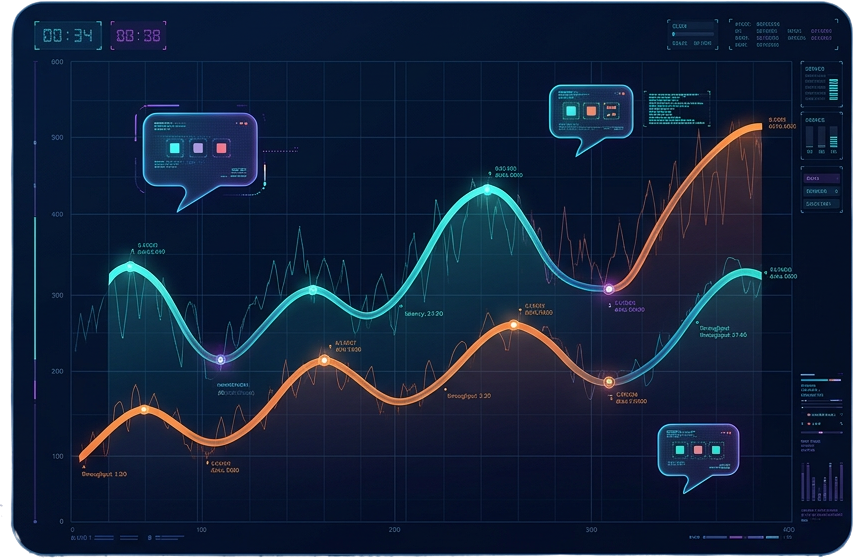
Every marketing team wants to catch a trend before it peaks, not after. That’s the appeal of AI for pinpointing social media trends: software that scans millions of posts, comments, and hashtags and tells you what’s rising before your competitors notice. The technology works. The problem is what happens after the alert lands on someone’s desk.
We work with operations and marketing leaders who’ve bought trend-detection tools, and most of them tell us the same thing. The software flags a shift accurately. Then the idea sits in a Slack thread for three days waiting on approval, or gets stuck behind a review process built for quarterly campaigns, not daily content. By the time anyone posts, the trend has moved on and the team has spent money proving a tool works while getting none of the upside.
What AI Actually Does Well Here
AI is genuinely good at pattern detection at a scale humans can’t match. It can track velocity of a hashtag across platforms, cluster related conversations that don’t share exact keywords, and flag sentiment shifts hours before they show up in a weekly report. According to HubSpot’s 2026 State of Social report, 94% of social media marketers now use AI in their workflows in some capacity, up from 71% just a year earlier. That’s not a niche capability anymore. It’s table stakes.
The gap isn’t detection. It’s response time. A trend-spotting tool can tell you something is happening right now. It can’t shorten your approval chain, rewrite your content calendar, or get legal sign-off faster. Those are process problems, and AI doesn’t fix process problems by sitting on top of them.
A Quick Example
Picture two companies that both adopt the same AI trend-monitoring tool. Company A plugs it into their existing workflow: the tool flags a trend, someone forwards it to the social media manager, who drafts a post, who sends it to a manager for approval, who sends it to legal for a quick check. Four days pass before anything ships, and the trend is already cooling.
Company B redesigns the workflow around the tool instead of bolting it on. They pre-approve content categories and tone guardrails so most trend-responsive posts don’t need a manager sign-off at all. They give the social media team a same-day publishing window for anything flagged as time-sensitive, with a lightweight after-the-fact review instead of a gate. The AI tool feeds directly into that faster process, and the team ships in hours, not days.
Same software. Completely different outcome. The difference is the workflow underneath it, which is exactly the point we make with clients working through our BRAVE framework: AI creates value when you rebuild the process around it, not when you drop it into a process built for a slower era.
Where This Fits Into Your Broader AI Strategy
This pattern shows up everywhere AI touches a business, not just social media. McKinsey’s 2025 State of AI report found that organizations seeing real financial returns from AI are far more likely to have fundamentally redesigned their workflows, while companies still bolting AI onto existing processes tend to stall in pilot mode. Social media trend detection is a small, visible version of a much bigger operational question: does your organization move fast enough to use the intelligence AI gives it?
That question matters more for small and mid-size businesses than most people assume. A large enterprise social team might absorb a slow approval chain because they have enough reach that a missed trend barely registers. A smaller team competing for the same attention doesn’t have that cushion. Speed is often the only edge you have against bigger budgets, and AI-detected trends are worthless if your operations can’t turn insight into action before the window closes.
What to Look at Before You Buy a Tool
Before adding another AI trend-monitoring platform to your stack, look honestly at three things:
- How long does content currently take to move from idea to published post, start to finish?
- Who actually needs to approve trend-responsive content, and does that list match who approves a planned quarterly campaign?
- What would you need to change in your process, not your tools, to cut that timeline in half?
If you can’t answer those questions with confidence, a new AI tool will just make the bottleneck more visible without making it smaller.
Building a Process That Matches the Tool
The businesses that get real value from AI-driven trend detection tend to do a few things differently. They separate time-sensitive content from planned content and give each a different approval path. They set clear boundaries in advance about what topics or tones are safe to move on quickly, so judgment calls don’t require a meeting every time. And they treat the AI tool as one input into a faster decision loop, not a replacement for the decision loop itself.
None of that requires a bigger team or a bigger budget. It requires looking at how work actually flows through your organization and being willing to change the parts that no longer fit the speed AI makes possible. That’s the operating system question, not the software question, and it’s the one most companies skip because it’s harder than signing a new vendor contract.
If you’re evaluating AI tools for social media or any other function and want a clear picture of how your current workflows would need to change to capture real value, our team at StrataBlue can walk through where the friction actually lives in your process. Get your free diagnostic and see exactly where a faster workflow, not just a faster tool, would make the biggest difference.