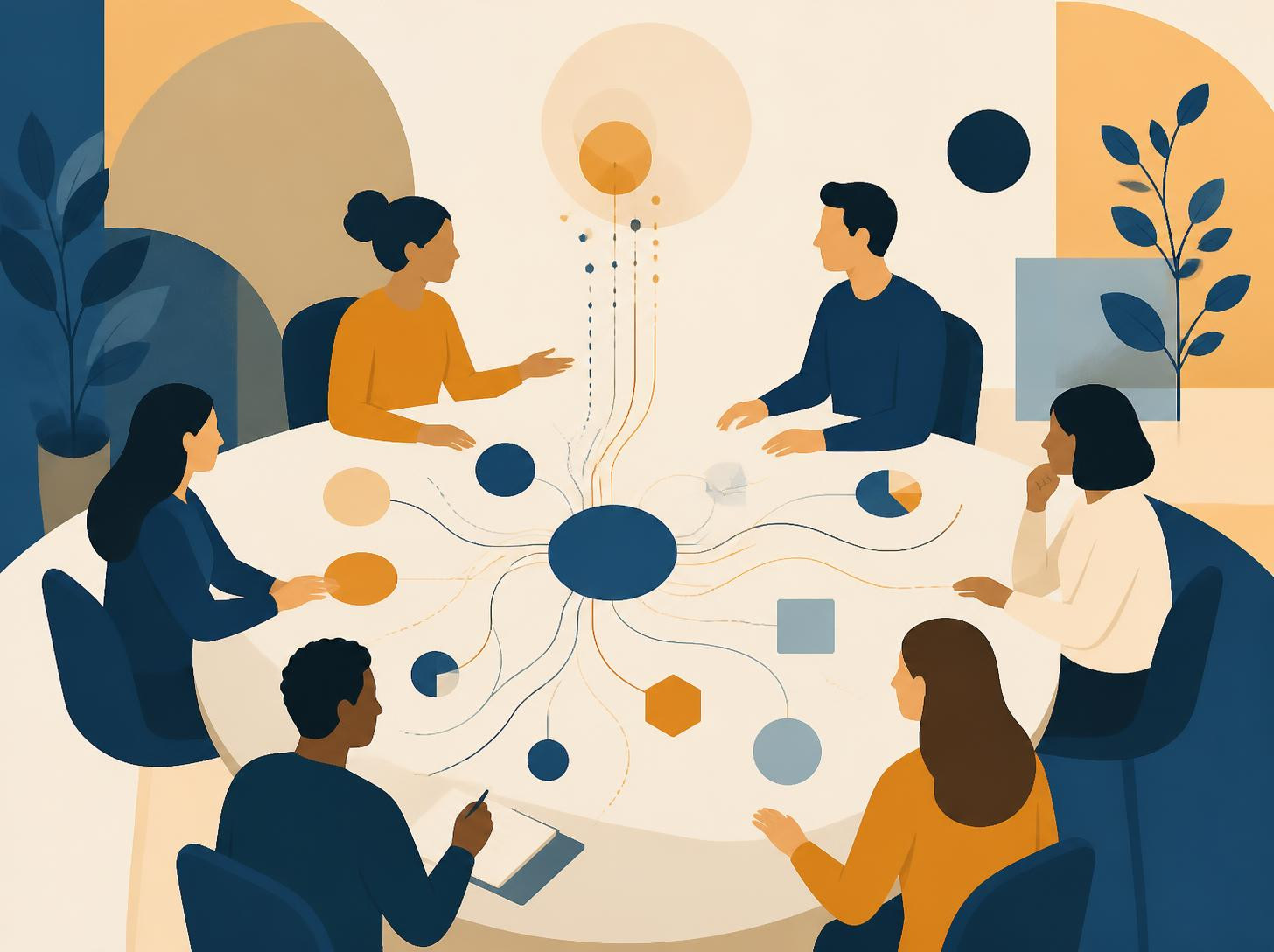
Ask most executives what “team building” means and they’ll describe a retreat, a trust exercise, or a Slack channel full of GIFs. Ask them what AI for team building means and you’ll usually get a blank stare, followed by a guess involving a chatbot that helps schedule happy hours. That gap is the problem. The teams pulling ahead right now aren’t the ones with the best offsite budget. They’re the ones who’ve redesigned how humans and AI actually work together, task by task, decision by decision.
We work with operations leaders every week who are trying to figure out where AI fits into how their people collaborate. The honest answer is that AI for team building isn’t a program you run once a year. It’s a structural choice about how work moves through your organization, and it has almost nothing to do with morale exercises.
Traditional Team Building Solves the Wrong Problem
Trust falls and personality assessments were built for a world where the main friction in teams was interpersonal: communication styles, unclear roles, competing incentives. Those problems still exist. But they’re no longer the biggest lever for performance. The bigger lever now is whether your team has actually rebuilt its workflows around AI or just bolted a tool onto an unchanged process.
McKinsey’s most recent State of AI research found that high-performing organizations are nearly three times more likely to have fundamentally redesigned individual workflows around AI, and that this redesign is one of the strongest predictors of real business impact. Most companies haven’t done it. They’ve added a tool to an existing team structure and called it transformation. The teams that are actually improving output have gone further. They’ve reassigned tasks between people and AI based on who’s genuinely better at each piece of the work.
That’s a team building problem. It just doesn’t look like one.
What the Research Actually Shows About AI and Teams
A widely cited field experiment led by researchers at Harvard Business School, sometimes referred to as “The Cybernetic Teammate,” ran at Procter & Gamble and found something specific enough to matter: individuals working with AI performed at a level comparable to two-person teams working without it. AI didn’t just make people faster. It reproduced some of the benefits people normally only get from collaborating with another human, and it did that by breaking down functional silos. Without AI, R&D staff proposed technical solutions and commercial staff proposed commercially-minded ones. With AI in the loop, that divide narrowed.
That finding should change how you think about team composition. If a well-designed AI workflow can replicate certain collaborative benefits, then the value of your human team shifts toward the things AI genuinely can’t do: judgment calls with incomplete information, relationship management, creative synthesis across contexts an AI hasn’t seen. Team building, in this frame, means figuring out where that human judgment is irreplaceable and building the workflow so people spend their time there instead of on tasks a well-configured AI system handles just as well.
This isn’t a call to replace people. It’s a call to be deliberate about who, or what, does which part of the work, and to build that structure on purpose instead of letting it happen by accident.
The Trust Gap Is Real, and It’s Not About Personality
There’s a second piece worth naming directly. A Harvard Business Review Analytic Services study found that a large share of leaders still trust AI agents only with limited, low-risk operational tasks, restricting them from core processes. That caution is often reasonable. But it points to something team building programs never address: trust in an AI-augmented team isn’t built through icebreakers. It’s built through clear rules about what the AI handles independently, what gets human review, and what escalates. Skip that step and you get a team that either over-relies on AI it hasn’t verified or ignores AI capability it should be using. Both failure modes look like “team dysfunction.” Neither gets fixed with a retreat.
Building Teams That Actually Work With AI
This is where the BRAVE framework earns its keep. We built BRAVE specifically because bolting AI onto an unchanged team structure doesn’t produce the results leaders expect. It’s a methodology for mapping what a team actually does, deciding deliberately which tasks belong to people and which belong to AI, and setting the escalation rules that make that split trustworthy instead of chaotic. That’s the actual work of AI for team building. It’s slower than an offsite and it’s a lot more durable.
Picture a mid-size marketing agency where account managers spend hours each week pulling campaign data into client reports, then a smaller amount of time actually interpreting that data and advising the client on strategy. Left alone, that team will “adopt AI” by having someone draft reports faster with a chatbot, then wonder why nothing changed. Redesigned around BRAVE, the AI owns data aggregation and first-draft reporting end to end, with clear rules for what needs human review before it reaches a client. The account managers get their time back for the part of the job that actually requires judgment: reading the client’s real concerns and shaping strategy around them. The team hasn’t gotten friendlier. It’s gotten more effective, because the roles were redrawn on purpose.
Where to Start
If you’re serious about AI for team building, start by mapping what your team does task by task before you buy another tool. Figure out where AI can replicate collaborative value, where human judgment is non-negotiable, and where trust needs explicit rules rather than assumptions. That’s uncomfortable work, and it’s the reason most organizations skip it in favor of a workshop. But it’s also the difference between a team that uses AI and a team that’s actually been rebuilt around it.
If you want help figuring out where your own team’s workflow breaks down, StrataBlue works through exactly this kind of redesign with operations leaders every week, and the best next step is usually to get your free diagnostic so you can see where the gaps actually are before you invest in more tools.