AI for home inspectors is everywhere right now, comment generators, photo-tagging tools, chatbots that answer your phone while you’re on a roof. Inspectors are buying these tools fast. Most of them aren’t seeing much change in their evenings. That gap isn’t a technology problem. It’s a workflow problem, and it’s the same one showing up across every industry that’s rushed into AI without rethinking how the work actually flows.
What AI for Home Inspectors Actually Looks Like Today
Report writing is where AI has landed hardest in this industry, and for good reason. Inspectors typically spend their days on-site and their evenings writing up findings, a pattern well documented by the U.S. Bureau of Labor Statistics. AI comment-assist tools now match dictated observations to pre-approved language, cutting the time it takes to turn a walkthrough into a finished report.
Computer vision is close behind. Instead of relying only on the inspector’s eye, AI models scan uploaded photos for cracks, moisture staining, and other red flags, acting as a second set of eyes rather than a replacement for the first. Some firms are layering in AI-powered scheduling and call handling too, so a missed call while you’re in a crawlspace doesn’t turn into a lost booking.
Drone and thermal imaging analysis is the newest addition, more common in commercial and roofing-specific inspections right now but moving into residential work as the hardware gets cheaper and the software gets better at flagging insulation gaps and electrical hotspots automatically.
Each of these tools solves a real, specific problem. None of them, on their own, solves the bigger one.
Why Most Home Inspectors Won’t See a Return on AI
Here’s the uncomfortable finding behind the AI hype cycle. MIT research on generative AI adoption found that 95% of pilot programs across industries delivered no measurable financial impact. The tools weren’t the problem. The failure came from treating AI as an add-on to existing processes instead of redesigning those processes around it.
McKinsey’s 2025 State of AI report backs this up with a number worth sitting with. Among organizations that report meaningful, measurable value from AI, 55% had fundamentally redesigned how the work itself gets done. Among everyone else, only 20% had. McKinsey calls workflow redesign one of the strongest predictors of AI actually paying off, stronger than which tool you picked or how much you spent.
Translate that to a home inspection business and the pattern is obvious. An inspector who adds an AI comment generator but still runs scheduling through one app, invoicing through another, and follow-up emails by hand hasn’t redesigned anything. They’ve added a faster typewriter to a slow system. The report gets written quicker, but the booking still gets missed while they’re under a house, the invoice still goes out a day late, and the referring agent still waits too long to hear the deal cleared.
Picture two inspectors doing the same ten inspections in a week. The first buys an AI writing tool and finishes reports thirty minutes faster each time, a real but modest gain. The second rebuilds the whole loop: online booking flows straight into a scheduling system, on-site dictation feeds directly into a drafted report, payment releases the report automatically, and a follow-up message goes to the agent the moment the file closes. The tools involved might overlap significantly. The difference is that the second inspector removed the handoffs between them instead of just speeding up one step in an otherwise unchanged process.
Building an AI-Enabled Inspection Business, Not Just an AI-Assisted One
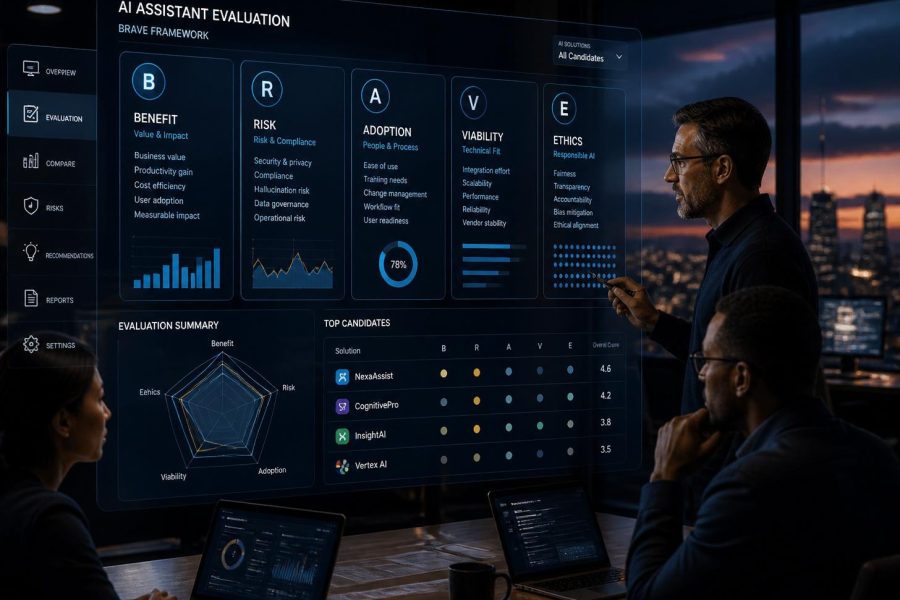
This is the distinction we build every engagement around at StrataBlue. We don’t start by asking which AI tool to buy. We start by mapping how work actually moves through a business, where it stalls, where it gets re-entered by hand, where a customer is left waiting because two systems don’t talk to each other. Only then do we design where AI fits into that redesigned flow. Our BRAVE framework exists specifically for this kind of operational rebuild, not a tool swap.
For a home inspection business, that usually means starting with the parts of the workflow that are already self-contained: on-site dictation and report drafting. That’s the low-risk entry point, and it’s where inspectors report the most immediate relief, often reclaiming the evening hours BLS data shows the job traditionally eats into.
The bigger return shows up at the next stage, when scheduling, payment, and agent communication get pulled into the same system as the report itself. That’s where the MIT and McKinsey findings stop being abstract and start showing up as fewer missed calls, faster payment cycles, and referring agents who notice the difference. It’s also where liability protection improves, since consistent, well-documented reports produced through a redesigned process tend to hold up better than ones assembled under time pressure at 9 p.m.
None of this requires building custom software from scratch. It requires deciding, deliberately, how the pieces should connect before you start buying pieces.
If you’re running an inspection business and wondering why the AI tools you’ve already added haven’t changed much, the answer probably isn’t the tool. It’s everything still happening around it. Visit stratablue.com to see how we approach that kind of redesign, or reach out and we’ll walk through what it would look like applied to your operation specifically.