
Key Highlights
-
Telecom voice agents are replacing outdated IVR systems with low-latency, conversational AI to improve the customer experience.
-
The core architecture relies on streaming Automatic Speech Recognition (ASR), quantized Large Language Models (LLMs), and real-time Text-to-Speech (TTS).
-
Key use cases include 24/7 self-service support for billing, technical issues, and account management, boosting customer satisfaction.
-
This AI agent technology significantly reduces operational costs and wait times by automating routine tasks.
-
Despite their benefits, these voice agents face technical constraints like latency, bandwidth requirements, and model scalability.
-
Successful implementation demands seamless integration with existing call center systems and a focus on data security.
Introduction
Telecom companies have long struggled with a reputation for poor customer service, largely due to inefficient and frustrating automated systems. Customers expect instant, personalized support, yet traditional Interactive Voice Response (IVR) systems create long wait times and high costs. Low-latency, end-to-end voice agents are a direct response to this failure, introducing a technological shift poised to fundamentally overhaul the telecom customer experience by delivering intelligent, human-like conversations.
Understanding Telecom Voice Agents

Telecom voice agents are more than just a simple upgrade to existing automated customer support. They represent a complete departure from the rigid, menu-driven systems that have defined customer interactions for decades. This technology leverages advanced AI to understand and respond to human speech in real time.
Instead of merely routing calls, this modern AI agent can manage full conversations, resolve issues, and perform tasks without human intervention. This capability is what makes them a transformative force in the telecom industry. The sections below will explain what these agents are and the technologies that power them.
Defining Telecom Voice Agents and Their Role in Customer Experience
So, what exactly is a telecom voice agent and how does it function? A telecom voice agent is a sophisticated AI-powered software system designed to communicate with users through natural, spoken language in real time. Unlike traditional virtual assistants that follow rigid scripts, these agents can understand context, manage interruptions, and engage in fluid conversations to resolve customer issues.
They work by integrating three core technologies. First, speech recognition captures and converts your words into text. Next, a language model processes the text to understand your intent. Finally, a text-to-speech engine generates a natural-sounding vocal response, creating a seamless conversational flow.
This approach directly addresses the shortcomings of old IVR systems, which force you into frustrating keypad menus. By enabling genuine dialogue, telecom voice agents dramatically improve the customer experience, leading to higher customer satisfaction and more efficient problem resolution.
How AI Powers Modern Telecom Voice Agents
Artificial intelligence is the engine that drives the functionality of a modern telecom AI agent. These systems rely on machine learning algorithms and advanced natural language processing (NLP) to interpret and respond to human speech with remarkable accuracy, making voice AI a practical tool for customer service.
This intelligent core is how AI voice agents are improving customer service in the telecom industry. They move beyond simple keyword matching to grasp the actual meaning and intent behind a customer’s words. This allows the agent to handle tasks that once required a human, from troubleshooting technical problems to managing account details.
AI empowers these agents to:
-
Provide 24/7 support without human oversight.
-
Analyze customer sentiment to adjust their tone and approach.
-
Learn from past interactions to continuously improve accuracy.
-
Personalize conversations based on user history and a central knowledge base.
Core Technologies Behind Voice Agents
The human-like performance of modern voice agents is not magic; it is the result of a carefully architected stack of technologies working in unison. The conversational ability of AI voice systems depends on three distinct but interconnected components that must operate with minimal delay to be effective in call centers.
This technological trio—speech recognition, language modeling, and speech synthesis—is what enables an AI voice to listen, think, and speak. Below, we examine each of these core technologies and explain its specific role in creating low-latency, end-to-end voice agents.
Streaming Automatic Speech Recognition (ASR)
Streaming Automatic Speech Recognition (ASR) is the first critical step in any voice interaction. Its job is to capture your spoken words and convert them into machine-readable text in real time. For conversational AI platforms to feel natural, this process must happen almost instantaneously as you speak, rather than waiting for you to finish a sentence.
This real-time capability is precisely how these platforms are used in telecom voice agents. Streaming ASR technology analyzes audio as it’s received, allowing the system to begin processing your request immediately. This minimizes the awkward pauses that plague older systems and is fundamental to achieving low-latency conversations.
Modern ASR systems are powered by neural networks that can adapt to different accents and filter out background noise, achieving high accuracy. This ensures that customer interactions start with a correct understanding of the user’s natural language, which is essential for providing effective customer service.
Quantized Large Language Models (LLMs)
Once your speech is converted to text, a Large Language Model (LLM) takes over. This is the “brain” of the AI agent, responsible for understanding the text, determining your intent, and formulating a relevant response. LLMs are trained on vast datasets, enabling them to comprehend context, nuance, and complex queries far beyond the scope of traditional keyword-based systems.
However, standard LLMs are often too large and slow for real-time customer support. This is where quantization becomes critical. A quantized LLM is a model that has been compressed to be smaller and more computationally efficient without a significant loss in accuracy. This optimization is key to reducing response times.
For a telecom AI agent handling thousands of concurrent calls, using a quantized model is not just an advantage—it is a necessity. It ensures the natural language processing component can generate answers quickly, preventing conversational delays and delivering a smooth user experience.
Real-Time Text-to-Speech (TTS) for Natural Conversations
The final piece of the puzzle is real-time Text-to-Speech (TTS) synthesis. After the LLM generates a text-based reply, the TTS engine converts that text back into audible, human-like speech. The quality of this output directly impacts the customer experience, as a robotic or choppy voice can immediately break the illusion of a natural conversation.
Modern voice AI utilizes deep neural networks for TTS, enabling it to produce speech with realistic intonation, rhythm, and emotional expression. This technology can even be customized to match a brand’s specific voice, ensuring consistency across all voice interactions.
For the system to maintain a low-latency flow, the TTS conversion must happen in real time. Any delay between the AI formulating a response and the customer hearing it creates a jarring pause. Therefore, a fast and high-quality TTS system is essential for creating the perception of a seamless, human-like dialogue.
Telecom Voice Agents vs. Traditional Solutions
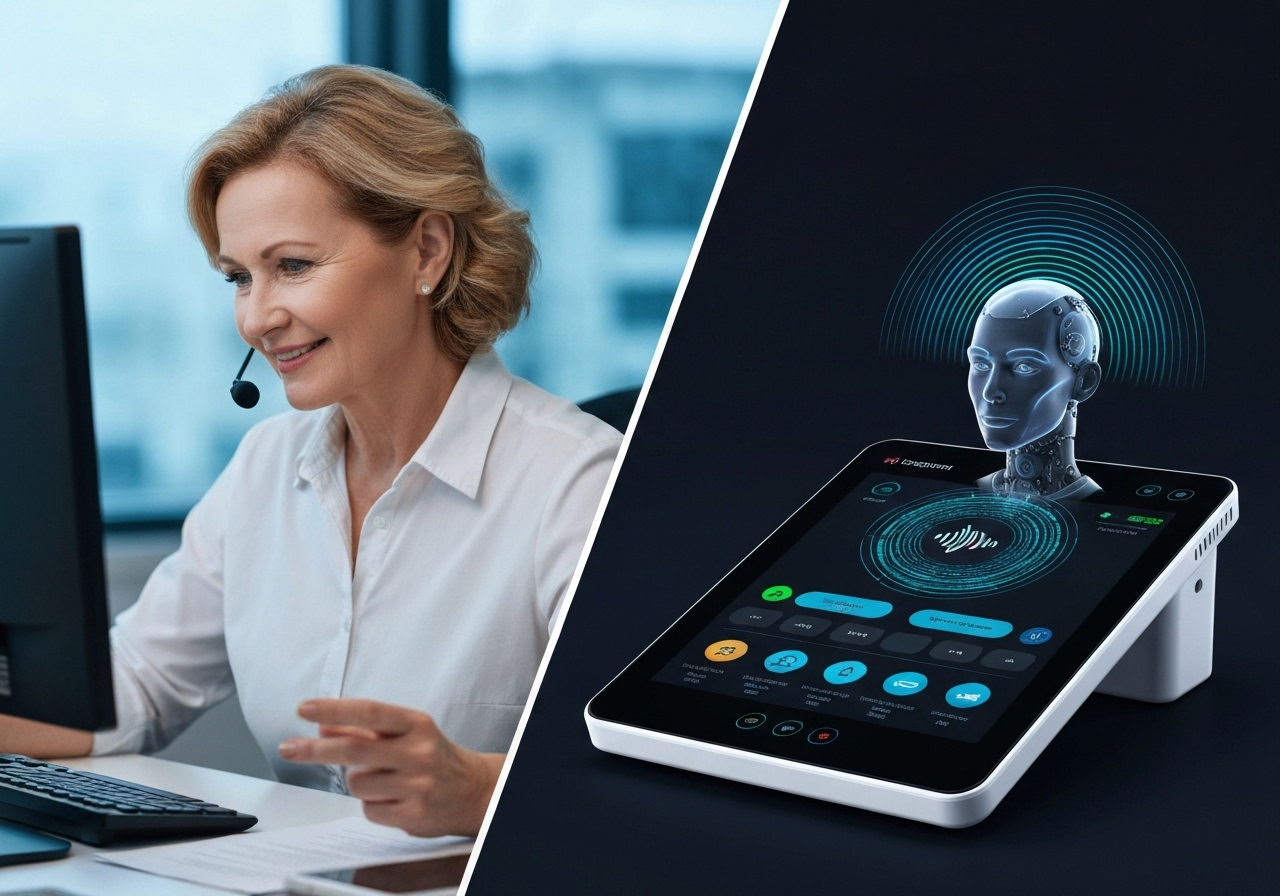
Comparing a modern telecom voice agent to traditional solutions is like comparing a smartphone to a rotary phone. While both serve a similar purpose, the underlying technology and resulting customer experience are worlds apart. Traditional IVR systems and even some human-led customer service models are proving inadequate for today’s consumer expectations.
The shift toward an advanced AI agent is driven by a need for greater speed, accuracy, and efficiency. The following sections break down the key differences between these new systems and their predecessors, highlighting why the move to AI is an inevitability for competitive telecom providers.
Key Differences in Speed and Accuracy
The main differences between traditional and AI voice agents in telecom are found in their speed and accuracy. Traditional IVR systems are notoriously slow, forcing users through rigid, linear menus to handle customer inquiries. Any deviation from the script often results in an error or a long wait to speak to a human, negatively impacting service quality.
In contrast, AI voice agents use advanced speech recognition and natural language understanding to interpret requests instantly. This dramatically shortens response times and allows for a more dynamic, non-linear conversation. The ability to understand intent rather than just keywords leads to far greater accuracy in addressing the customer’s actual needs.
This leap in performance directly boosts customer satisfaction by eliminating the friction and frustration common in older systems. The following table illustrates these differences more clearly.
|
Feature |
Traditional IVR/Voice Agent |
Modern AI Voice Agent |
|---|---|---|
|
Interaction |
Rigid, menu-driven (e.g., “Press 1 for billing”) |
Conversational, natural language (“I have a question about my last bill”) |
|
Response Times |
Slow, dependent on navigating menus |
Instantaneous, real-time responses |
|
Accuracy |
Low; struggles with accents, background noise, and complex requests |
High; uses advanced speech recognition and context awareness |
|
Task Handling |
Limited to simple, pre-programmed tasks |
Can handle complex, multi-step tasks and transactions |
|
Availability |
24/7, but with limited functionality |
24/7 with full conversational and transactional capabilities |
Human-Operated Call Centers versus AI-Powered Agents
While human agents provide empathy that AI cannot yet fully replicate, AI-powered voice agents offer distinct advantages in call centers, particularly regarding operational costs and scalability. A single AI voice agent can handle thousands of concurrent calls, a feat impossible for human support teams without massive investment.
This automation frees human agents from handling repetitive, high-volume inquiries, allowing them to focus on more complex and emotionally charged issues where their skills are most valuable. By offloading routine tasks, businesses can streamline operations and reduce costs associated with hiring, training, and managing large support teams.
The key advantages of an AI voice agent over relying solely on human-operated call centers include:
-
Drastic reduction in operational costs.
-
24/7/365 availability without extra staffing.
-
Consistent service quality that doesn’t vary with agent mood or fatigue.
-
Instant scalability to manage unexpected peaks in call volume.
Integration with Existing Call Center Systems
An AI solution is only as effective as its ability to integrate with the tools a business already uses. For a telecom voice agent to deliver real value, it cannot operate in a silo. It must seamlessly connect with existing call center infrastructure, including CRM platforms, helpdesk software, and other critical business systems.
This integration is what allows the AI to perform meaningful actions, such as accessing customer history, updating account information, or processing a payment. The following sections explore how modern voice agents achieve this integration and the common challenges that arise during implementation, which are crucial for any successful deployment in customer support.
Plug-and-Play Approaches for Telecom Environments
So, how do telecom voice agents integrate with existing call center systems? The most effective approach is through “plug-and-play” solutions that are designed for ease of integration. Instead of requiring a complete overhaul of business operations, these platforms use APIs and pre-built connectors to link with the tools telecom companies already rely on.
This means your AI agent can be connected to your customer database, knowledge base, and payment gateways with minimal custom development. The agent can then pull customer data for personalization, search help articles for answers, and execute tasks directly within your existing workflows.
The benefits of a plug-and-play AI agent include:
-
Faster deployment times compared to custom-built solutions.
-
Lower initial implementation costs.
-
Seamless data flow between the AI and other business systems.
-
A unified framework for managing interactions across voice and digital channels.
Overcoming Common Implementation Challenges
Despite the promise of plug-and-play solutions, the implementation of a voice AI agent is not without its hurdles. One of the most significant technical issues is ensuring the AI can correctly understand the context of a conversation, which requires continuous training with diverse and clean data. An agent that misinterprets requests will only create more frustration.
Another challenge is integrating with legacy business systems. Many telecom companies rely on older, proprietary software that may not have modern APIs, making seamless connection difficult and potentially increasing support costs. Data security and privacy are also paramount, as voice interactions often involve sensitive information that must be protected.
Overcoming these obstacles requires a clear strategy. Start with well-defined goals for a limited set of use cases, ensure your data is clean and accessible, and choose an AI platform that prioritizes both robust integration capabilities and stringent security protocols to improve customer support effectively.
Benefits for Telecom Providers and Customers
The adoption of an AI voice agent delivers a powerful dual benefit, positively impacting both telecom providers and their customers. For providers, the primary advantages are a dramatic increase in operational efficiency and a significant reduction in service costs. Automating high-volume interactions allows businesses to scale their support without proportionally increasing headcount.
For customers, the benefits translate directly into higher customer satisfaction. They get instant answers, avoid long wait times, and receive support whenever they need it. The following sections will detail how these agents provide 24/7 availability and boost personalization, creating a win-win scenario.
24/7 Availability and Reduced Wait Times
One of the most significant benefits of using an AI-powered voice agent for telecom providers is the ability to offer 24/7 availability. Unlike human-staffed call centers, an AI agent never sleeps. This ensures customers can get help at any time of day, on any day of the year, which is a major factor in improving the overall customer experience.
This constant availability directly addresses one of the biggest pain points in customer service: long wait times. An AI agent can handle thousands of calls simultaneously, meaning customers are no longer placed in long queues during peak hours. This immediate access to support reduces frustration and enhances customer engagement.
For telecom providers, this capability leads to:
-
Drastically reduced call wait times and abandonment rates.
-
The ability to manage sudden spikes in call volume without service degradation.
-
Lowered costs associated with staffing overnight or holiday shifts.
-
Improved customer satisfaction scores by providing instant resolutions.
Boosting Personalization and Customer Satisfaction
Modern voice agents go beyond simply answering questions; they enable a new level of personalization in customer interactions. By integrating with a company’s CRM and accessing historical customer data, an agent can greet you by name, reference your past issues, and understand your preferences without you needing to repeat yourself.
This is further enhanced by technologies like sentiment analysis. The AI can detect frustration, confusion, or satisfaction in your tone of voice and adjust its responses accordingly. For example, it can offer more empathetic language if it senses you are upset or escalate the call to a human if it determines your customer needs require a different approach.
This tailored experience makes you feel understood and valued, which is a powerful driver of customer satisfaction. By using data to anticipate needs and adapt in real time, voice agents transform a generic service call into a personalized and efficient interaction.
Real-World Applications and Industry Use Cases

The theoretical benefits of voice AI are compelling, but its true value is demonstrated in real-world applications. Across the telecom industry, these agents are already being deployed to handle a wide range of customer service tasks, proving their effectiveness in high-volume environments. These use cases show how an AI agent can deliver tangible results.
From automating simple inquiries to managing complex transactions, the applications are diverse. The following sections highlight two of the most impactful industry use cases: replacing outdated IVR systems with intelligent self-service and enabling seamless multilingual support for global operations.
Automated IVR and Self-Service Options
One of the most immediate applications of telecom voice agents is the complete replacement of traditional IVR systems. Instead of being forced to listen to a long list of options and press keys, customers can simply state what they need in their own words. These advanced voice bots can handle a wide array of self-service tasks that previously required human intervention.
For example, a customer can call and say, “I need to check the status of my internet installation,” or “Why was my bill higher this month?” The AI agent can understand these customer inquiries, access the relevant data, and provide a direct answer or guide the user through a resolution.
Common self-service use cases include:
-
Checking account balances and making payments.
-
Troubleshooting technical issues.
-
Scheduling appointments for installations or repairs.
-
Upgrading or changing service plans.
While complex issues may still be escalated, this automated front line resolves the vast majority of routine requests.
Supporting Multilingual and Multiregional Operations
For telecom companies with global operations, providing effective multilingual support is a major logistical and financial challenge. Hiring human agents fluent in dozens of languages is often impractical. This is an area where voice AI provides a transformative solution.
A single AI voice agent platform can be configured to communicate fluently in numerous languages, instantly breaking down communication barriers. This ensures that customers around the world can receive high-quality support in their native tongue, leading to clearer and more effective customer service interactions.
Furthermore, advanced speech recognition models are trained to understand many different accents and regional dialects within a single language. This capability ensures that the voice AI can assist a diverse customer base, making global support scalable, consistent, and cost-effective.
Technical Limitations and Practical Constraints
While the potential of telecom voice agents is immense, it is critical to acknowledge the technical limitations and practical constraints that can hinder their performance. Deploying this voice technology at scale is not a simple task, and providers must be aware of the underlying technical issues to set realistic expectations and plan accordingly.
The most significant challenges revolve around managing the real-time demands of live conversation, including bandwidth and latency, and addressing the sheer size and computational cost of the AI models. These constraints are the primary focus for engineers working to make the AI agent even more robust and accessible.
Managing Bandwidth and Latency in Live Conversations
The success of a voice AI hinges on its ability to operate in real time. Any perceptible delay, or latency, between you speaking and the agent responding shatters the illusion of a natural conversation and leads to frustration. For live calls, the entire process—from speech recognition to response generation—must occur in milliseconds.
Achieving this low latency is a significant technical challenge. It requires substantial bandwidth to stream high-quality audio and a highly optimized AI pipeline to process it instantly. In environments with poor internet connectivity, latency can increase, leading to a choppy and disjointed user experience.
Managing this is non-negotiable. If the voice AI is slow, users will talk over it, the system will misinterpret requests, and the call will ultimately fail. Therefore, a robust network infrastructure and efficient model architecture are prerequisites for any successful real-time voice agent deployment.
Addressing Model Size and Scalability at Telecom Scale
Another major constraint is the size and complexity of the machine learning models themselves, particularly large language models (LLMs). These models require immense computational power to run, which presents a scalability problem when deploying an AI voice agent at telecom scale.
Handling tens of thousands of concurrent calls means a provider must have access to a massive amount of processing power, which can be prohibitively expensive. This is why research into model optimization, such as quantization, is so critical. Creating smaller, faster models that retain high accuracy is key to making large-scale deployments economically viable.
The challenge of scalability is not just about handling volume but also about maintaining performance. As more users interact with the AI voice agent, the system must be able to allocate resources dynamically to ensure that every single caller experiences the same low-latency, high-quality interaction.
Conclusion
In conclusion, telecom voice agents are not just a passing trend; they are fundamentally changing the landscape of customer experience in the telecommunications sector. By leveraging advanced technologies such as streaming ASR, quantized LLMs, and real-time TTS, these agents provide unparalleled speed, accuracy, and personalization. As businesses integrate these cutting-edge solutions into their call center operations, they can expect to see significant improvements in customer satisfaction, reduced wait times, and enhanced service availability. However, navigating the technical limitations and practical constraints inherent in these systems is crucial for successful implementation. Embracing this shift will empower telecom providers to meet the evolving demands of their customers effectively. For a more in-depth exploration of how these voice agents can benefit your company, consider booking a free consultation with our experts today.
Real-time transcription
Real-time transcription is a foundational feature of modern voice agent systems, providing an immediate, text-based record of a conversation as it happens. This capability stems directly from the streaming speech recognition technology that powers the agent’s “hearing.” As the AI converts spoken words to text to understand the user, it can simultaneously generate a live transcript of the call.
This feature is invaluable when a call needs to be escalated to a human agent. Instead of forcing the customer to repeat their issue, the human agent can instantly read the transcription of the conversation so far. This provides immediate context on the problem, the steps already taken, and the customer’s sentiment, allowing the agent to pick up the conversation seamlessly and resolve the issue faster.
Real-time transcription
Real-time transcription also plays a critical role in compliance, quality assurance, and training. For regulated industries like telecom, having an accurate, searchable record of all customer interactions is essential for demonstrating compliance with legal and regulatory requirements. Transcripts provide an easily auditable trail of what was said and agreed upon during a call.
Furthermore, these transcripts can be used to monitor the performance of both the voice agent and human agents. Managers can review conversations to ensure quality standards are being met and identify areas for improvement. The data from these customer interactions can also be used as a training set to further refine the AI models, making the system smarter and more accurate over time.
Frequently Asked Questions
Can telecom voice agents handle complex customer requests?
Yes, an AI agent can handle many complex issues by guiding users through multi-step processes. However, the best systems are designed to recognize the limits of automation. For truly nuanced or emotionally charged customer needs, the agent will seamlessly escalate the interaction to a human agent, ensuring a positive outcome through timely human intervention.
Are AI-powered voice agents secure and privacy-compliant?
Security and privacy are critical. A reputable AI voice agent solution from Stratablue must include end-to-end encryption and adhere to strict data protection regulations like SOC 2 and GDPR. This ensures that sensitive customer data handled during calls is protected from unauthorized access, maintaining compliance and building trust with your users.
What separates telecom voice agents from chatbot solutions?
The primary distinction is the channel. A chatbot communicates via text, whereas an AI agent uses voice technology. This requires more advanced capabilities, including sophisticated speech recognition and text-to-speech synthesis, to manage the complexities of spoken dialogue. The natural language understanding must account for tone, accents, and interruptions, making it a different challenge for customer service.